A fact check on efficiency, area coverage—and new challenges
More and more often, we hear people say, “The performance of PV modules has tripled in recent years.” Sounds impressive—but is it really true? In this article, we shed light on what “performance” actually means in PV modules, how surface area, efficiency, and quality have developed—and why simply looking at watt peak is not enough.
What does “watt peak” mean?
The rated power of a PV module—specified in watts peak (Wp)—is determined under standard test conditions (STC): 1,000 W/m² irradiation, 25 °C cell temperature, and defined spectral distribution. The flash test provides this value and is a standard procedure in module testing.
👉 You can find out more about the STC test and flash test in our technical article.
Yes, modules are significantly more powerful today—per surface area.
Around ten years ago, standard modules (60 cells, polycrystalline) had an output of around 250–270 Wp on an area of approx. 1.6 m² – that's around 160 W/m². Modern modules with larger cell formats (e.g., 182 mm half-cells, monocrystalline) achieve 550–600 Wp on 2.3–2.4 m² – i.e., >250 W/m².
📈 The area output has therefore increased by approx. 60–70%, which has been made possible primarily by higher cell efficiencies and larger active cell areas.
Low-light efficiency: Higher yield with less sun
An often overlooked advancement in modern PV technology is improved low-light efficiency:
Newer cell technologies such as PERC, TOPCon, and HJT deliver higher yields than older cells, even in diffuse sunlight, cloudy conditions, or in the morning and evening hours. This is a decisive advantage, especially for locations with less than optimal orientation or at higher latitudes.
But: More watts ≠ automatically better quality
In addition to impressive progress, there are also critical developments that are often overlooked—particularly due to ongoing price pressure in the industry:
1. Larger modules = higher mechanical stress
The standard size of PV modules has grown significantly in recent years, with lengths exceeding 2.30 m and areas exceeding 2.4 m². To save weight and costs, thinner aluminum frames have often been used, some with lower alloy quality.
➡️ The bending stiffness decreases, which can lead to higher mechanical stress on the cells—especially in wind, snow, or during transport.
➡️ This increases the likelihood of cell breakage and microcracks, with potential long-term damage and loss of performance.
2. Quality control under pressure
The enormous cost pressure—especially in the low-price segment—is increasingly leading to the neglect of strict quality controls in production.
In practice, we often see modules with inadequate lamination, poorly manufactured junction boxes, or optical defects that can affect performance in the long term.
3. Average underperformance in flash tests (Fraunhofer ISE)
A recent analysis by Fraunhofer ISE—based on over 70,000 flash tests conducted in its CalLab since 2012—shows that since around 2017, laboratories have regularly measured lower outputs than those specified by manufacturers. Click here to view the publication.
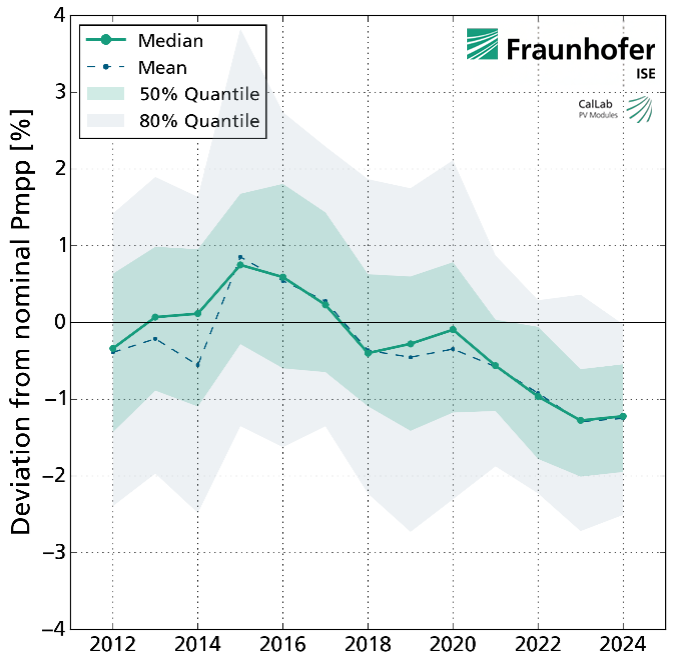
- Until 2016, the deviations were mostly positive or below 1%..
- 2023 an average underperformance of −1.3% was observed
- 2024 shows a slight improvement, but at −1.2% remains below the manufacturer's value
This shortfall of around 1–1.3% may seem small, but for market-scale new installations (e.g., 16.2 GWp of new capacity in Germany in 2024), this corresponds to a loss of output of around 195 MW—roughly the nominal output of a very large ground-mounted PV system.
Conclusion: Progress with downsides
Yes—modern PV modules deliver more power per surface area, are more efficient in low light, and use larger active cell areas. However, more watts peak does not automatically mean better quality.
Anyone deciding on new modules today—whether for new construction or repowering—should pay attention not only to performance and price, but above all to build quality, mechanical stability, and reliable test reports. Because true performance is not reflected in the data sheet—but in the yield over 20+ years.
Tip: At 2nd Cycle, we check used PV modules for all relevant quality characteristics—electrical, optical, and mechanical—thus extending their life cycle in a safe and traceable manner. 👉 Learn more about PV module testing